Redesigning Vagaro's 8-Year-Old Signup Flow to Reduce Drop-off and Improve Lead Quality
Increasing conversion, improving lead quality, and reducing friction on mobile where 76% of signups happen.
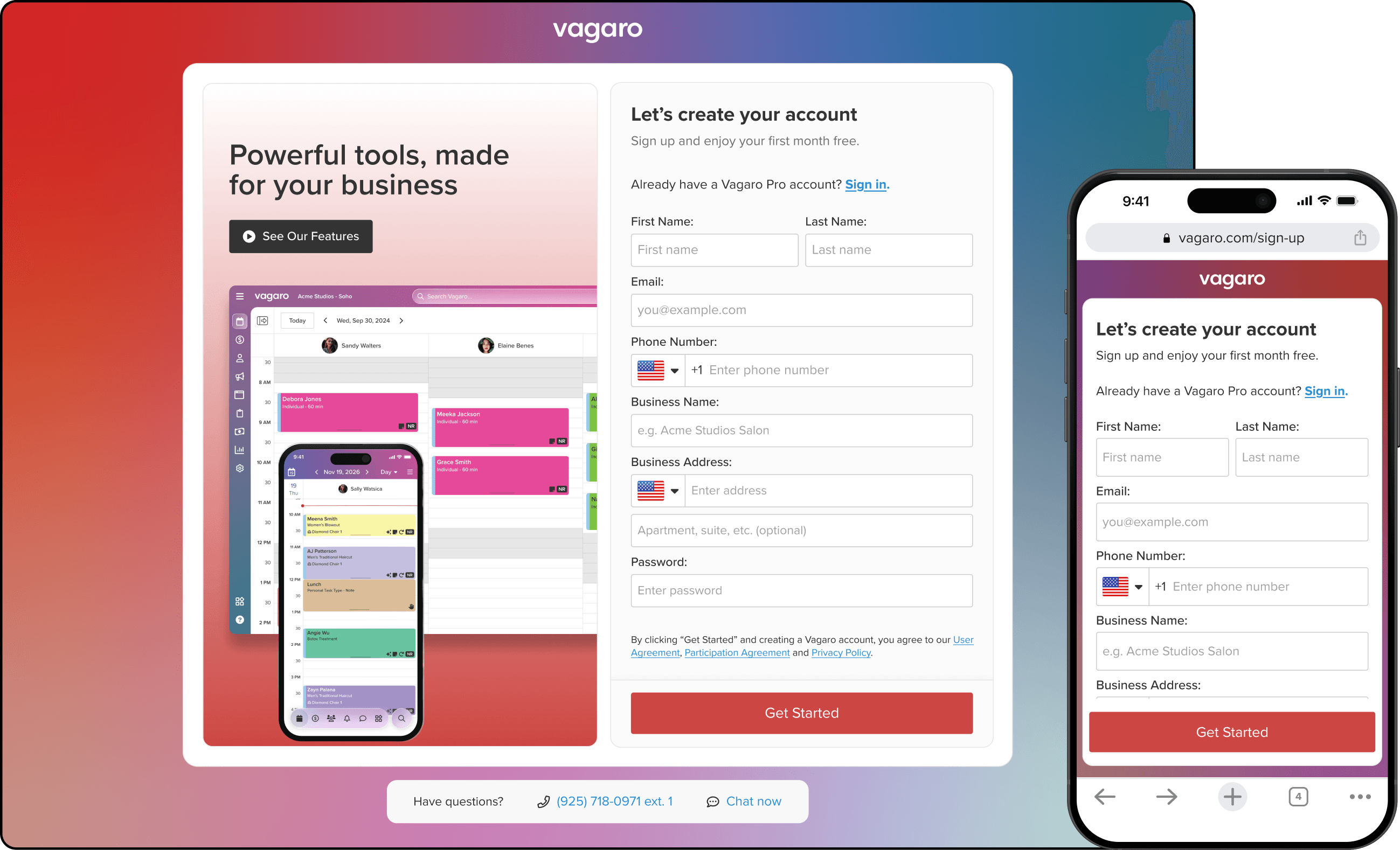
Vagaro's signup flow had not been updated in 8+ years. It asked for too much too early, was nearly unusable on mobile (where 76% of signups happened), and leaked ~30% of users before they ever reached payment.
A mobile-first redesign: fewer fields on the opening screen, 100+ service checkboxes cut to a handful of business-category chips, and a payment step with visible security cues plus a secure link that lets customers signing up over the phone enter card details themselves, without the sales rep ever seeing them.
+18 pts funnel conversion, app signups up 69% year over year, lead capture up from 62% to 84%, and an estimated $2.4M increase in new-user ARR.
The Problem
The old signup flow lost users before they were fully committed
The flow created friction in three different places.
- Step 1 of the signup flow asked for too much information too early, which required a lot of scrolling on mobile and effort to fill up.
- Step 2 asked users to choose their business type from too many options, which made it feel overwhelming. Even though most users completed it, data showed they were spending too much time deciding, adding avoidable friction.
- Sales also lost around 15% of sales-assisted signups because customers felt uncomfortable sharing credit card details over the phone.
The hard part was deciding what to ask and when. Sales, Marketing, and Analytics each needed something from this flow, and those needs did not always point in the same direction.
Original flow
Step 1: Personal info
Step 2: Business type
Step 3: Payment
Goal
Design a signup that earns user trust at every step
Balance user momentum with Sales lead quality, Marketing attribution, and Analytics tracking.
The project was guided by three questions that I aligned the team around early:
- How do we make signing up feel effortless without losing the lead data Sales and Marketing depend on?
- How do we retain enough user context for personalized onboarding if someone drops off mid-funnel?
- How do we help users confidently enter payment details, including in sales-assisted scenarios where they should never have to share card info over the phone?
Data Reveal
Funnel data made the problem specific before any design work began
I pulled funnel data from Amplitude to quantify drop-off across each step. Steps 1 and 3 showed the steepest losses.
Step 1
~45%
drop-off, especially on mobile
Step 2
90%
completion rate
Step 3
~30%
drop-off at payment
Step 2 was working at 90%. The losses were concentrated at the start and the end of the flow.
Funnel Analysis
Drop-off rate by step
Design Solutions
Three connected design moves
Reducing friction at the top, preserving intent in the middle, and building trust at the bottom.
01
Capturing leads without losing momentum
Fewer fields for the user, better lead data for Sales.
Step 1 had the highest drop-off and was the most complex to redesign. It needed to serve Sales (lead capture), Marketing (attribution), and Analytics (tracking) while feeling effortless to users.
- Reduced inputs to essential fields
- Removed security questions and other non-essential fields
- Designed mobile-first: device and browser autofill, correct keyboard type per field
This meant that even if a user dropped off after Step 1, Sales had a complete, qualified lead to follow up on.
Redesigned flow: core lead fields only
02
Preserving a lightweight commitment step
A deliberate tradeoff: one extra step to improve activation quality and long-term retention.
Redesigned flow: high-level business category chips, lightweight and fast
The Tradeoff
Step 2 had relatively high completion rates (90%) but asked users to choose from over 100 service options. From a pure conversion standpoint, removing it would have reduced friction further.
However, eliminating this step would have degraded onboarding quality and increased setup effort post-signup.
The Decision
Instead of removing the step, I cut what it asked for. The redesigned step:
- Presents only high-level business categories as selectable chips
- Avoids exposing granular service options during signup
- Remains visually lightweight and fast, especially on mobile
We kept this step because:
- It creates early emotional investment and clarity
- It powers AI-generated business descriptions later in onboarding
- It enables pre-population of services and classes, reducing post-signup setup friction
We kept a step that pure conversion math said to cut. Activation quality mattered more to us than funnel length.
03
Designing for trust and sales-assisted edge cases
Trust signals at checkout, plus a private way to pay for sales-assisted signups.
The credit card step caused major drop-offs. Trust signals were weak, alternative payment methods were absent, and the sales-assisted path had no way for users to enter card details privately.
- Added security indicators (SSL badges, card brand logos, “Secure checkout” text)
- Introduced Apple Pay and Google Pay to reduce manual entry
- Added autofill, auto-tabbing, and field-appropriate keyboards
- Designed a secure sales-assisted flow: Sales sends a one-time secure link via email or SMS, the user enters payment privately, then chooses to continue self-serve or resume assisted support
This solved a real revenue leak. The ~15% of sales-assisted signups that stalled because customers would not read card numbers over the phone now had a private way to pay.
Redesigned flow: Apple Pay, Google Pay, security indicators, and faster card entry
Prototype
See the full sign-up flow
Impact
Results and impact
We compared the redesigned flow against the previous flow over six weeks, measured against the same six weeks a year earlier when the old flow was live.
Funnel Conversion Rate
Share of users who began signup at Step 1 and completed payment at Step 3.
App Signups Year Over Year
Signups through the mobile app grew 69% against the same period last year. Mobile was the primary target of the redesign, since 76% of signups start there.
Lead Capture Rate
Increased full contact capture in Step 1 from 62% to 84%, giving Sales higher-quality leads even when users did not complete payment.
Estimated Increase in ARR from New Users
The redesigned signup flow is estimated to generate $2.4M in new annual recurring revenue, driven by higher paid conversion and improved sales recovery.
$2.4M
Reflection
The shortest funnel is not the best funnel
Step 2 was the one I got wrong.
I expected the fix to be subtraction. Step 2 proved otherwise. It completed at 90%, and cutting it would have raised conversion while making onboarding worse. A step that costs a little friction up front can save real work after signup, and that trade is worth making more often than conversion math suggests.